This route dives into the history of the United Fruit Company and the Standard Fruit and Steamship Company during the early to mid 20th-century in New Orleans. These companies had a lasting disastrous impact on the economic, political and social landscapes in Latin American countries. Journalists took to calling United Fruit “el pulpo” (“the octopus”) because its tentacles were everywhere. The exploitation enacted on Latin American countries and people is yet another form of oppression that needs to be called out and fought against.
[su_spoiler title=” Click here to see suggested turn-by-turn directions and stop info for this 10.7 mile route.” open=”no” style=”default” icon=”plus” anchor=”” class=””]
Turn by turn directions can be found here: https://goo.gl/maps/qUkP6FZtZnQABLy38
Stop A: Chartres & Desire[su_expand height = “50”]The Standard Fruit and Steamship Company had a wharf here in the 1930s. The Standard Fruit Company was established in 1924 by brothers Joseph, Luca, and Felix Vaccaro , along with fellow Sicilian immigrant Salvador D’Antoni (although, unlike his older brothers, Felix Vaccaro was born in New Orleans). Standard was renamed the Standard Fruit and Steamship Company in 1926.
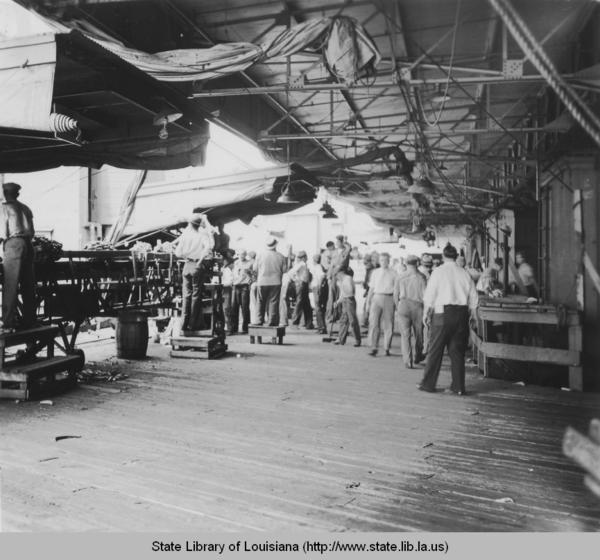
By 1968, Standard Fruit had been acquired by the Castle & Cooke Corporation, which also purchased the Dole Hawaiian Pineapple Company. In the 1990s, the entire conglomeration was renamed as the Dole Food Company.
[/su_expand]
Stop B: United Fruit Company’s old headquarters[su_expand height = “50”]As the facade reads, starting in 1920 this was a UFC office. In the 1930s, Samuel Zemurray became the president of the United Fruit Company, and in 1933 he moved its headquarters to New Orleans. Zemmurray was previously the president of Cuyamel (which is now Chiquita), and in 1910 had been involved in the overthrow of the government of Honduras.
The banana trade had devastating and violent social and political effects in many Latin American countries. For an in depth look at the “Banana Republics” and Banana Wars, watch this documentary, Banana Land: Blood, Bullets & Poison. As a Colombian resident says in this film, “If we take a look at our social and political surroundings, we see that they are scarred by the money of multinational banana companies and their mad desire to seize land, maintain economic power, and to keep the community and society in a state of economic and social slavery.”

[/su_expand]
Stop C: Tulane School of Public Health and Tropical Medicine [su_expand height=”50″]As related on the TSPHTM website: “The Tulane School of Hygiene and Tropical Medicine began in 1912 with a donation from New Orleans businessman Samuel Zemurray. F. Creighton William served as the school’s first dean from 1913-1914, and was succeeded by William H. Seeman. In 1919, the School of Hygiene and Tropical Medicine merged with the College of Medicine. Degree programs for the Master of Public Health (MPH) and Master of Public Health and Tropical Medicine (MPH&TM) began in 1947, with doctoral programs beginning a few years later in 1950.” (https://matas.tulane.edu/about/history-tulane-university-school-public-heath-tropical-medicine)[/su_expand]
Stop D: Thalia Street Wharf[su_expand height=”50″] This was another wharf that was used exclusively by the United Fruit Company. In the 1870s, before the formal foundation of The United Fruit Company, its future owners Minor Cooper Keith and Andrew Woodbury Preston were each dabbling in their own respective banana businesses, with Keith involved in helping his uncle Henry Meiggs with the construction of a railroad in Costa Rica to connect the capital, San José, to the port city of Limón. Meiggs was a powerful railroad contractor in South America, having built lines in Chile and Peru and amassing vast wealth. The Costa Rican line began construction in 1871, and was troubled from the start. Meiggs died in Peru in 1877, and Keith took over managing the project. About 5,000 Central Americans died during this construction, due to yellow fever outbreaks that were exacerbated by poor sanitary and health conditions in the labor camps. Keith turned to using prison labor from New Orleans to finish the project, but also utilized Jamaican, Chinese, and Italian laborers as well. New Orleans may have sent as many as seven hundred inmates to work on the railroad, with as few as twenty-five surviving the hellish experience.
During the course of construction of the railroad, Keith had begun experimenting with bananas as a cheap, bountiful, and local source of food for laborers. In 1870, Bananas were a relatively rare delicacy in the United States, but from the mid-1870s on Keith began importing the fruit from Limón to the port of New Orleans. Unlike the railroad itself, banana importation was wildly successful, and Keith quickly became a dominant force in the burgeoning Central American banana trade.
Meanwhile in Boston, Andrew Preston became interested in founding a larger banana import company, and eventually was part of a group of ten men who in 1887 founded the Boston Fruit Company. Preston and the Boston Company invested heavily in Jamaican agricultural land and so controlled the source of their bananas, but Preston also developed refrigerated distribution networks in the United States to sell bananas outside of major seaports. In 1899, Preston’s Boston Fruit Company merged with Keith’s Tropical Trading and Transport Company to form the behemoth United Fruit Company. United Fruit soon began to gobble up other companies, not all of them banana-related. For instance, in 1901 the Guatemalan government hired United Fruit to manage the country’s postal service.
From Emily Perkins and the Historic New Orleans Collection, read the essay “Bananas, quarantines, and the octopus: United Fruit Company’s PR stunt in Central America”: https://www.hnoc.org/publications/first-draft/bananas-quarantines-and-octopus-united-fruit-companys-pr-stunt-central
This wharf was also known to be the epicenter of the 1905 yellow fever outbreak in New Orleans, which began when Italian laborers unloading a shipment of bananas contracted the illness (which is spread by mosquitoes). The disease quickly spread through the city, and federal authorities eventually fumigated the city. By the time the city brought the epidemic under control in October of 1905, a total of 452 people had died.
Finally, the Port of New Orleans is also connected to an initial, failed attempt to overthrow the democratically elected government Guatemalan President Jacobo Árbenz. In 1952, the Central Intelligence Agency began holding meetings with representatives of Carlos Castillo Armas, a former officer in Guatemalan Army living in partly self-imposed exile in Nicaragua after earlier coup attempts against Árbenz. Those meetings developed in Operation PBFortune, which was financed by the United States (via the CIA), the United Fruit Company (which was concerned about threats to its status as Guatemala’s largest land owner), and the right-wing dictators of Nicaragua, Venezuela, and the Dominican Republic.
Using a cargo boat lent to them by the United Fruit Company and weapons (including 250 rifles, 380 pistols, 64 machine guns, and 4500 grenades) seized by customs inspectors at ports in New York City, the CIA retrofitted the boat and prepared to ship the weapons to Armas’ forces in Nicaragua. To disguise the contents of the ship, the CIA paperwork falsely identified the weapons as “farm equipment,” and Armas and the CIA began planning for an April 1953 coup.
Ultimately, though, both the Nicaraguan and Honduran Ambassadors raised questions about the boat’s actual contents, and the operation was scuttled by President Eisenhower. The CIA, however, continued to fund Armas, and in June 1954 Armas led military forces into Guatemala from El Salvador and Honduras and overthrew Árbenz.
(For more on Operation PBFortune and shameless CIA intervention in Guatemala, see – among many, many other works – https://scholarworks.uark.edu/cgi/viewcontent.cgi?article=3072&context=etd or https://www.cia.gov/library/readingroom/docs/DOC_0000135796.pdf). Alternately, The Harvard Business Review has a conversation with Professor Geoffrey Jones, discussing the 1954 coup and the role of United Fruit: https://hbr.org/podcast/2019/07/the-controversial-history-of-united-fruit, or check out this “story map” from Adam Kellar and Jaren Foster about the so-called “Banana Wars” in Honduras, Guatemala, and other nations impacted by colonial capitalism: https://storymaps.arcgis.com/stories/1c0c992fe46b47e8a411e96f5f69f2de [/su_expand]
Stop E: Sam “BananaMan” Zemurray’s old home[su_expand height = “50”]…is now used as the president of Tulane University’s house. Zemmuray’s actions largely served his business interests, to the detriment of the people of Honduras, Guatemala, and Cuba. Here’s a clip from drunk history about “Sam the Banana Man” Zemurray: http://www.cc.com/video-clips/bgoxo5/drunk-history-the-scarface-of-bananas
The United Fruit Company lives on today, although now in the guise of “Chiquita Brands International Incorporated.” UFC began using the brand name “Chiquita” in the 1940s and 1950s, but did not formally adopt the name for the entire corporation until 1989.
Samuel Zemurray’s daughter Doris, who grew up in this house, and her husband Roger Thayer Stone founded Tulane’s Latin American Studies Center.
[/su_expand]
[/su_spoiler]
While you are riding, bring masks and hand sanitizer, respect physical distancing, and make sure that you have an emergency contact who knows where you are and can pick you up if needed. We also have some more in-depth tips for safe biking in the pandemic, check them out! Please be aware that NOLA to Angola cannot provide logistical or emergency support to individual riders this year. Take care, and safe riding!