This route focuses on prison justice organizations working in New Orleans and Louisiana, alongside historical sites of carceral injustice in the city. These stops are meant to highlight the many ways that incarceration affects individuals, families, and those doing the work to fight the prison industrial complex.
NOLA to Angola aims to connect with, partner with and uplift the work of these important organizations. We would love to hear your input about other organizations and their efforts: leave a comment below!
To start off this route, take a few minutes to watch this video by the Equal Justice Initiative which talks about the history of slavery and the modern day slavery of the carceral system.
[su_spoiler title=” Click here to see suggested turn-by-turn directions and stop info for this 14 mile route. ” open=”no” style=”default” icon=”plus” anchor=”” class=””]
Turn by turn directions can be found here: https://goo.gl/maps/SyuPFMiK3rwpmQAV8
Stop A: Old Carrollton Courthouse[su_expand height = “50”]The Carrollton Courthouse was constructed in 1855, and later became the site of McDonogh 23 and then Ben Franklin High School. During its nineteen years in operation as a courthouse, people were sentenced to death and hanged behind the building. In 1858, there was a case of voter intimidation by an “armed gang,” many of whom were members of the New Orleans Police Department. The aim of the mob was to ensure that Benjamin Mason was elected as the Mayor of Carrollton, instead of the “Citizens” ticket candidate. Carrollton District Judge Victor Burthe declared the election null and void and ordered another election. However, Benjamin Mason appealed to the Louisiana Supreme Court, and the election was upheld, despite the obvious violence and voter suppression.
The Carrollton courthouse was also the site of a legal decision that could only possibly be seen as progressive in the context of the antebellum United States: in 1858, Judge Burthe heard the case Joseph Tom v. The Slave Ernest, in which Tom sued for the right to seize Ernest and sell him to pay for expenses Tom had incurred while (forcibly, since Ernest was not free to leave) keeping Ernest in his home from the time Ernest was five until he was ten. Tom asked Judge Burthe to declare Ernest as a piece of property, but Judge Burthe rejected that argument and wrote in his judgement “Slaves are persons, not things, and cannot therefore be seized provisionally. It is therefore ordered adjudged and decreed that the writ of provisional seizure be set aside at plaintiffs’ costs.” Despite appeals to higher courts, Joseph Tom was unable to convince even Louisiana authorities of the justness of his desire to treat a child as a thing to be seized and sold. Make no mistake though: the legal decisions in the various suits all supported the larger institution of slavery, whatever marginal weight they may have given to Ernest’s obvious personhood. In that sense, Tom v. Ernest shares a dubious place in United States legal history with other manifestly unjust decisions as Dred Scott v. Sanford and Homer A. Plessy v. Ferguson.[/su_expand]
Stop B: Orleans Parish Prison[su_expand height = “50”]Orleans Parish Prison is the usual starting place for our annual NOLA to Angola ride. To get involved with current issues related to OPP and the prison system in Louisiana, the Orleans Parish Prison Reform Coalition and Voice of the Experienced are great places to start.
OPPRC’s mission: The Orleans Parish Prison Reform Coalition (OPPRC) is a diverse, grassroots coalition of individuals and organizations from across New Orleans who have come together to shrink the size of the jail and improve the conditions of confinement for those held in detention in Orleans Parish. Founded in 2004, OPPRC members include community activists, lawyers, service providers, organizers, formerly incarcerated people, and their family members. https://opprcnola.org
VOTE’s mission: VOTE is a grassroots organization founded and run by formerly incarcerated people (FIP), our families and our allies. We are dedicated to restoring the full human and civil rights of those most impacted by the criminal (in)justice system. Together we have the experiences, expertise and power to improve public safety in Louisiana and beyond without relying on mass incarceration. https://www.vote-nola.org
[/su_expand]
Stop C: Ubuntu Village[su_expand height = “50”]Ubuntu’s mission is to provide programming that delivers social, economic, and transformational justice to children and communities. We work primarily with youth who are involved in the criminal justice system and their families. Our program involves immediate triaging and connecting to services as well as longer term educational planning, skills development, mentoring, and leadership development. This includes anti-oppression training, know your rights curricula, restorative parenting discussions, participatory action research, and history lessons.
As they move through Ubuntu, families and youth gain job skills, feel more confident in their ability to navigate systems in their lives including the courts, address the harm inflicted by institutionalized violence, support each other, and eventually become leaders in their communities. Ubuntu operates under a harm reduction model in which we acknowledge the reality of participants’ lives and the very serious choices they face. We prioritize providing immediate economic opportunities to participants and families as well as developing strategies for long-term economic sustainability. https://ubuntuvillagenola.org[/su_expand]
Stop D: The Cabildo[su_expand height = “50”]Currently a facility of The Louisiana State Museum, the courtyard of the Cabildo was the location of a city prison complex for nearly two hundred years. Constructed in 1730, the building contained a military and civil prison, along with a police station.The Great Fire of 1788 damaged this Cabildo, and another fire in 1794 destroyed other parts of the complex. In 1799, the second Cabildo was completed, and this is the structure you see today. In the 1830s, the city authorized plans to expand the notoriously overcrowded jail and also built a second parish prison, which is now the Municipal Auditorium near Armstrong Park.[/su_expand]
Stop E: The Promise of Justice Initiative[su_expand height = “50”] The Promise of Justice Initiative (PJI) is a New Orleans based nonprofit that works to create positive change for people in the criminal justice system at the intersection of direct services, impact litigation, and community engagement. We believe in a world where our justice system values each person; a world where the system supports rehabilitation, and a world where we approach justice with a lens of healing and restoration for those who are harmed. This world will be safer and more secure for all people. https://promiseofjustice.org [/su_expand]
Stop F: Resurrection After Exoneration[su_expand height = “50”]After spending eighteen years in prison for a murder he did not commit (fourteen of those years on death row), John “JT” Thompson eventually won a retrial in 2003 and then acquittal. After his release, JT quickly discovered the near complete absence of services for folks who were exonerated (as opposed to released on parole, for instance), and founded Resurrection After Exoneration to support other exonerees. JT sued the prosecutors who hid evidence in his original 1984 trials, winning a fourteen million dollar judgement against the State of Louisiana. The State appealed, and JT fought all the way to Supreme Court., where a 5-4 decision of the Court took that money away (read Justice Ruth Bader Ginsburg’s widely-praised dissent here, which forcefully takes up JT’s cause. As Justice Ginsburg wrote, “What happened here …was no momentary oversight, no single incident of a lone officer’s misconduct. Instead, the evidence demonstrated that misperception and disregard of [rules regarding evidentiary] disclosure … were pervasive in Orleans Parish. That evidence, I would hold, established persistent, deliberately indifferent conduct for which the District Attorney’s Office bears responsibility.”).
Despite that and other setbacks, JT became a resolute advocate for exonerees and for broader criminal justice reform. He was unsparing in his criticism of prosecutorial misconduct and judicial complicity in the harshness of the Louisiana justice system. However, he was an equally loud voice calling for defense attorneys to work in concert with their clients, to advocate against both the everyday indignities of the prison and courts, and to fight for a more fair and balanced court system. In addition to his work, JT was a warm and loving friend, father, husband, and co-worker, and a fountain of energy and new ideas. Among the projects which would not exist without his inspiration is this one, NOLA to Angola, which was created after co-founder Matt Toups heard JT speak. Matt began gathering friends and collaborators, and ten years later NTA is still growing and changing.
JT died in 2017. In his memory, Matt wrote to a group of riders and NTA organizers to honor JT, his work, and his friendship to each of us as individuals and a fledgling organization:
JT’s words in “Voices of Innocence” were the catalyst for our small group of young folks who tried to make a difference with a wacky idea years ago: to ride our bikes to the infamous remote state prison at Angola, in order to support folks on the inside and their families struggling on the outside of this enormous monster of a prison system in our state. The idea for the ride was born immediately after hearing him speak at Loyola University.
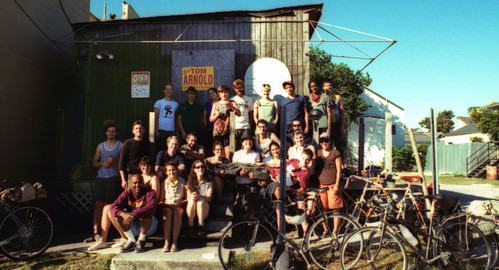
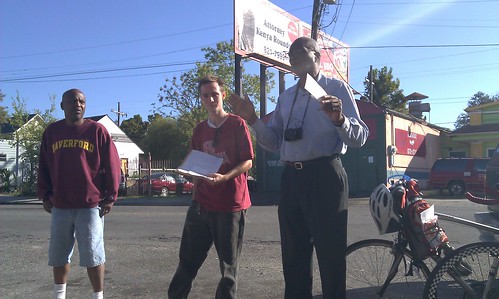
It is fitting that he joined us at the very first NOLA to Angola send-off on St. Bernard Avenue on October 14, 2011 in front of RAE. I hope we can all remember that day with pride and acknowledge that, like so many things he touched, it would have never happened without his courage and inspiration. Scott Eustis recorded the moment: (JT can be seen in the maroon “Haverford” sweatshirt)
As for Kyle Duncan, the attorney who argued against JT at the Supreme Court and won a judgment that stripped JT of the money he deserved for the injustice against him? Well: he is a Donald Trump-appointed judge for the Federal Fifth circuit, and actively working to undermine abortion access, among other activities. [That first link is to an editorial by Laverne Thompson, JT’s wife. Go read it!]
[/su_expand]
Stop G: Louisiana Center For Children’s Rights[su_expand height = “50”]The Louisiana Center for Children’s Rights is a nonprofit law office that defends young people in Louisiana’s justice system through both direct representation and policy advocacy. LCCR’s mission is: Using direct representation and advocacy, we fight to keep children out of the justice system so that they can thrive in their homes and communities. LCCR’s vision is: We envision a Louisiana where every child, no matter their race or class, is free to be a kid and supported in becoming a healthy adult. https://www.laccr.org
[/su_expand]
Stop H: Women With a Vision[su_expand height = “50”]Women With A Vision is a community-based non-profit, founded in 1989 by a grassroots collective of Black women in response to the spread of HIV/AIDS in communities of color. Today our major areas of focus include Sex Worker Rights, Drug Policy Reform, HIV Positive Women’s Advocacy, and Reproductive Justice outreach. https://myexistenceispolitical.com [/su_expand]
Stop I: Orleans Public Defenders[su_expand height = “50”]OPD’s mission is to fight for our clients by providing excellent client-centered representation, reforming the system and partnering with the community. Check out this video about why public defense matters: https://www.facebook.com/63780893907/videos/10154454601078908[/su_expand]
Stop J: First 72+[su_expand height = “50”]The First 72+ aims to end the cycle of incarceration by fostering independence and self-sustainability through education, stable and secure housing & employment, health care, and community engagement. Through the leadership and wisdom of formerly incarcerated people themselves, the First 72+ transforms the re-entry experience into one that builds on the strengths and abilities of people returning home from prison and ensures that they, their families, and their communities are given the greatest opportunity to grow and thrive. Check out this video from the First 72+ below:
Rising Foundations/First 72+ VIDEO + PITCH from NOVAC on Vimeo.
[/su_expand]
[/su_spoiler]
While you are riding, bring masks and hand sanitizer, respect physical distancing, and make sure that you have an emergency contact who knows where you are and can pick you up if needed. We also have some more in-depth tips for safe biking in the pandemic, check them out! Please be aware that NOLA to Angola cannot provide logistical or emergency support to individual riders this year. Take care, and safe riding!